



For decades, financial services have obsessed over one question: who are you?
Know Your Customer (KYC) rules turned that question into an entire industry. Banks verify identities, fintechs screen customers, payment providers monitor transactions, and merchants spend billions trying to distinguish legitimate users from fraudsters.
But the rise of AI agents is introducing a strange new participant into that system. Increasingly, the person making a transaction might not actually be a person.
AI agents are moving beyond recommending what to buy towards actually doing the buying: searching for products, comparing prices, booking travel, managing subscriptions and eventually completing payments autonomously.
That creates a new identity problem for fintech.
If an AI agent turns up at a merchant and tries to spend £800 on someone's behalf, the merchant needs to answer a different set of questions. Who owns this agent? Is it legitimate? What exactly has the customer authorised it to do? And, crucially, who is responsible if it does something they didn't ask for?
In other words, fintech may soon need Know Your Agent (KYA) alongside Know Your Customer.
Walmart Ask Sparky: AI-powered shopping moves closer to agentic commerce
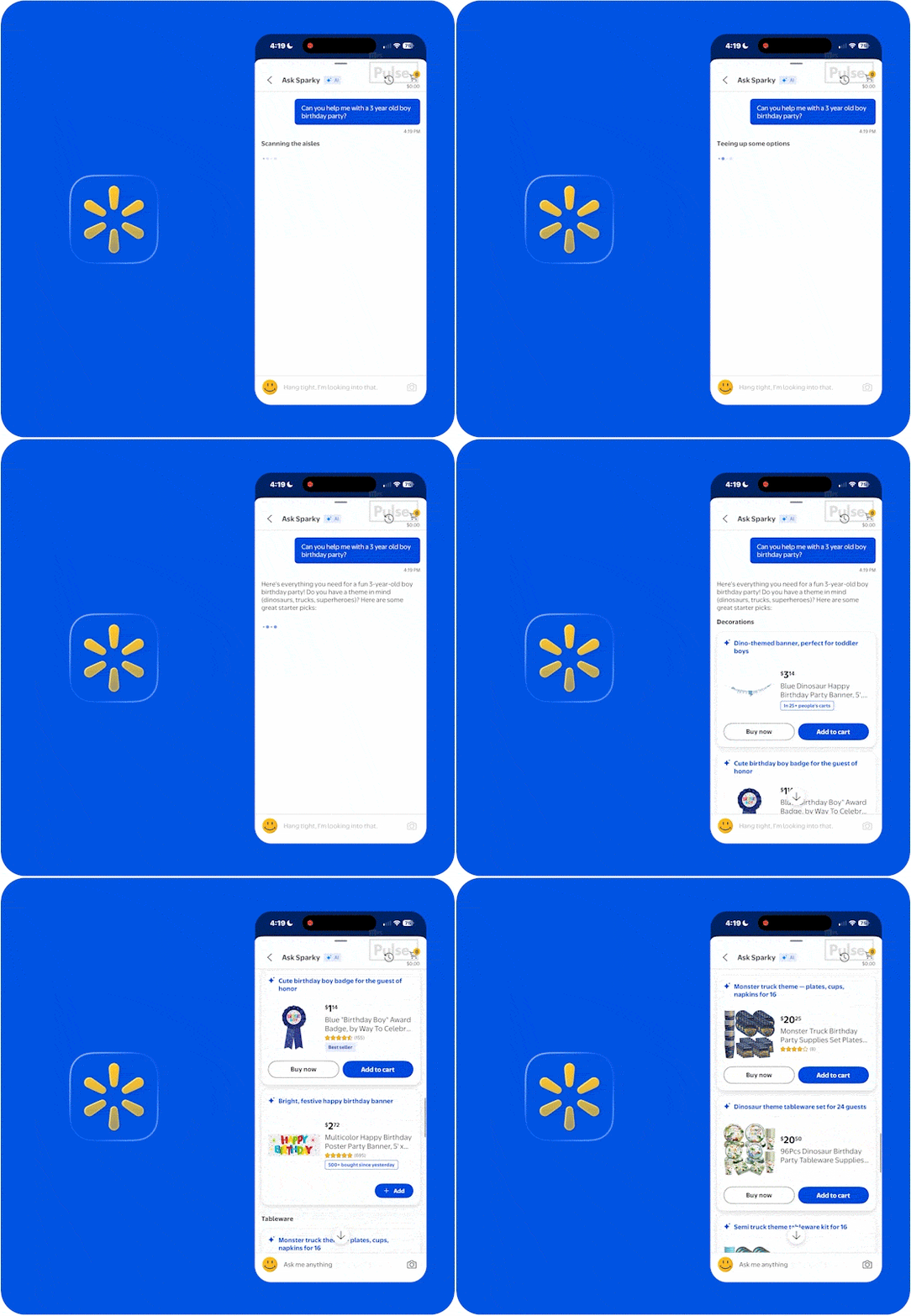
Walmart’s Ask Sparky shows how AI is moving beyond product search to become an active shopping assistant. Users can describe what they need, from planning a child’s birthday party to finding products for a particular theme, and Sparky researches options, recommends relevant products and provides direct routes to add them to the cart or buy them.
This is a clear step towards the agentic commerce: as AI takes on more of the shopping journey, the next evolution is allowing agents to complete purchases themselves, making questions around identity, permission and customer intent increasingly important.
From bot detection to agent identity
The problem is that much of today's internet infrastructure was designed around a relatively simple distinction: human or bot.
Bots were typically something businesses tried to detect and block. But an AI shopping agent complicates that model. It might look like automated traffic while actually representing a valuable customer who has explicitly asked it to transact.
Visa is already trying to solve this problem.
Its Trusted Agent Protocol is designed to help merchants distinguish approved AI agents acting with commercial intent from malicious bots. Agents can cryptographically sign requests, allowing merchants to verify that they are participating in an approved programme and that their requests haven't been tampered with.
Visa's specification also includes mechanisms for linking agents to consumer identity and payment information. That's an important shift.
Instead of asking whether traffic is automated, merchants may increasingly need to ask which agent is this, and should I trust it?
And Visa isn't alone.
In January, identity verification company Sumsub launched AI Agent Verification, built around what it explicitly calls a Know Your Agent framework. The system binds an AI agent to a verified human identity, creating a chain of accountability between the software taking an action and the person behind it.
Essentially, KYC verifies the customer. KYA could verify the software acting for them.
Identity isn't enough. Fintech also needs to verify intent.
Knowing who owns an agent only solves half the problem.
Imagine telling an AI assistant: Find me a flight to Barcelona next weekend for under £300.
The agent finds one for £260 and buys it. Easy.
But what if it finds a £450 flight? Or adds a hotel? Or upgrades you to business class because it determines that's a “better” option?
The important question is no longer simply whether you are authorised to make the payment. It's whether the agent was authorised to make that specific payment.
Mastercard is tackling this issue with Verifiable Intent, which it has developed with Google. The framework creates a tamper-resistant record linking the cardholder, their instructions and the interaction between the agent and merchant that results in a purchase. Mastercard says that if a dispute occurs, the parties can use this audit trail to establish what was actually authorised.
Mastercard's broader Agent Pay push is already moving beyond theory. It completed Australia's first fully authenticated agentic transactions in January, followed by New Zealand's first in February. It's also working with partners in both markets on AI-driven procurement, where agents could source from approved suppliers, place orders and initiate payments on behalf of businesses.
That suggests payments could evolve from a simple binary, approved or declined, towards something more programmable.
An agent might be authorised to spend up to £500, but only with certain merchants. It might be allowed to renew your broadband contract, but not switch providers without confirmation. A corporate procurement agent might buy software licences but only from an approved vendor list.
Warba Bank Bdr AI: Turning conversations into financial actions

Warba Bank’s Bdr AI shows how conversational AI is moving beyond answering questions to helping customers execute financial actions. Users can simply tell the assistant what they want to do, with Bdr AI gathering the necessary details, preparing the action and presenting it for confirmation before proceeding.
From transferring money between accounts to creating payment requests, the experience demonstrates the shift towards AI taking greater responsibility within a customer’s financial life, exactly the transition that makes concepts such as Know Your Agent and verifiable intent increasingly important as AI becomes capable of acting on customers’ instructions.
Your AI might eventually have its own wallet
Perhaps the clearest sign of where this is heading came from an unexpected player: Cloudflare.
In August, the internet infrastructure company announced Cloudflare Wallets and cloudflare.pay, infrastructure designed to give AI agents persistent identities and the ability to transact within limits set by their human owners. The products are designed so businesses can identify who's behind an agent while agents can make purchases on their owner's behalf.
The interesting thing here isn't the wallet itself. It's the architecture around it.
We're beginning to see an identity stack emerge for autonomous software: identify the human, identify the agent, establish the relationship between them, define what the agent is allowed to do, and create evidence of what it actually did.
That's remarkably similar to the trust infrastructure financial services spent decades constructing around humans and businesses.
But who pays when the agent gets it wrong?
Underneath all of this sits a thornier question: liability.
If an agent exceeds its instructions, who eats the loss? The customer who deployed it? The company that built it? The merchant that accepted the transaction? Or the payment provider that authorised it?
There isn't yet a universal answer. But it's precisely why the emerging focus on verifiable intent matters.
An audit trail showing what a customer authorised, what permissions an agent held and what it actually did isn't just useful for fraud prevention. It could become critical evidence when something goes wrong.
Mastercard explicitly positions Verifiable Intent in these terms. Its framework is designed to create a shared record of authorisation that consumers, merchants and issuers can rely on, including when a transaction is disputed.
In that sense, KYA may ultimately be as much about accountability as identity.
KYC was built for people. KYA could be built for delegation.
There is still a long way to go before AI agents routinely control consumers' money. Standards remain fragmented, liability questions aren't fully resolved, and consumers may be understandably reluctant to hand an algorithm an unlimited credit card.
But Visa, Mastercard, Sumsub and Cloudflare are all attacking variations of the same problem.
The next phase of agentic commerce isn't simply about making AI smart enough to buy things. It's about making the financial system smart enough to trust software that buys things for us.
For decades, fintech's identity problem was proving that you are who you say you are. Its next one might be proving that your AI really is yours, and that it did exactly what you told it to.
Thousands more journeys waiting for you...
Explore every journey featured in this article in full on 11:FS Pulse, alongside other best-in-class examples such as Robinhood’s Cortex and Klarna’s Shopping Assistant - all backed by expert analysis and exclusive scoring for you to benchmark your products against.
11:FS Pulse is the industry-leading product research tool for designers, product teams and researchers, combining real user journeys from the world’s biggest financial brands with exclusive insights from people who know financial services inside out.
Book your no commitment discovery call with our team today to see it for yourself.