.svg)
.svg)


If you listened to the headlines, you'd think the competitive race in financial services is about one thing: building the smartest AI.
We think that's the wrong way to look at it.
Within a few years, many financial services providers will have access to remarkably capable foundation models. At the same time, conversational AI is fundamentally changing how customers interact with financial services. Together, these shifts are redefining where the competitive advantage will come from.
The firms that succeed won't necessarily be those with the most capable models. They'll be the ones that earn customers' trust one interaction at a time, to the point they are comfortable letting their assistant influence and, eventually, act on their financial decisions.
As AI assistants increasingly mediate how customers discover, compare and choose financial products, the assistant they trust will increasingly influence where customers choose to do business. In a conversational world, trust becomes the gateway to distribution.
The challenge has changed
The timing matters because AI assistants are no longer simply answering questions. They are beginning to compare financial products, recommend actions, monitor spending, identify savings opportunities and, in some areas, execute tasks on behalf of customers.
That changes more than the customer experience. It changes how financial products are discovered, evaluated and ultimately chosen.
For decades, financial providers have competed to own the customer relationship through branches, websites, mobile apps and comparison sites. Conversational AI introduces something fundamentally different: an intelligent intermediary sitting between financial providers and the people they serve.
This shift is already underway. Lloyds Banking Group estimates that more than 28 million of 56 million UK adults have used AI tools to help manage their money over the past year, with ChatGPT the most commonly used platform. For the first time, financial providers must compete not only for the customer's attention, but also for the recommendation of the interface increasingly shaping their financial decisions.
The consequences extend far beyond a new customer interface. The assistant customers trust will increasingly influence which products they discover, which providers they consider and, ultimately, where they choose to do business.
Financial providers aren’t simply competing to build better AI. They're competing to ensure they remain part of the customer's decision-making journey as AI assistants become an important gateway to financial products and services. Firms that fail to earn customers' trust risk seeing third-party AI assistants mediate more of the customer relationship, weakening their influence over product discovery and distribution. Ultimately, trust will determine which firms retain influence over customer relationships and distribution in a conversational world.
How to earn enough trust to remain part of the customer relationship
Trust isn't binary; it's progressive. Customers don't leap from asking an assistant to explain a mortgage to letting it choose one on their behalf. They grant permission one step at a time, with each successful interaction earning the next level of responsibility. And because money is inherently high stakes, financial AI has to earn that trust differently from a general-purpose chatbot.
We believe three principles will determine which firms earn that trust, and, in doing so, remain part of customers' financial lives:
1. Trust is earned through outcomes
Much of today's AI conversation revolves around model performance; Which model reasons better? Which one has the largest context window? Which one produces the most accurate responses? These are important questions for engineers, but they're unlikely to determine which assistant customers trust with their finances.
Customers judge assistants by whether they consistently help them achieve better financial outcomes. In financial services, trust has always been earned through reliability, accuracy and good judgement rather than technical sophistication.
The assistant that helps customers save money, avoid mistakes, understand complex products and make better decisions will earn trust. In practice, this means shifting attention from model capability to customer value.
- Differentiate through expertise, not models. As foundation models become increasingly commoditised, competitive advantage will shift towards proprietary financial expertise, customer context, product integration and the quality of decisions an assistant helps customers make.
- Make every interaction count. Trust compounds. Every successful interaction increases confidence in the next one, making accumulated customer trust far harder for competitors to replicate than simply adopting a newer language model.
- Prioritise measuring customer outcomes over technical metrics. Response quality and benchmark scores matter, but they are only proxies. Success should ultimately be measured by whether assistants help customers complete tasks, make better financial decisions and achieve better financial outcomes.
Financial services providers have spent decades building trusted customer relationships. The opportunity now is to translate that trust into conversational experiences rather than assuming the model itself will create differentiation.
Case study: Cleo
Measuring success by financial progress
Cleo's Autopilot demonstrates what it means to design an AI assistant around customer outcomes rather than conversation quality.
Instead of simply answering questions, the assistant analyses a customer's income, bills and spending to build a personalised financial Roadmap, then creates a daily plan to keep them on track.
It can recommend concrete actions such as moving money into savings, avoiding an overdraft or limiting spending with particular merchants, and continually adjusts those recommendations as a customer's circumstances change.
Most importantly, Cleo measures success by whether those interventions improve progress towards the customer's financial goals, rather than by the quality of the conversation itself. The assistant earns trust because customers can see it helping them make better financial decisions.

2. Trust must be built progressively
One of the biggest mistakes firms could make is assuming customers will quickly become comfortable delegating important financial decisions to AI. That's not how trust works. Customers don't suddenly move from asking an assistant to explain a mortgage to letting it choose one on their behalf.
Instead, trust develops through a series of successful interactions. As confidence grows, customers gradually increase the level of responsibility they are willing to give an assistant, moving from information to guidance, recommendations and, eventually, execution.
Explaining a financial concept requires relatively little trust. Asking an assistant to recommend a product requires more. Allowing it to execute a transaction or move money on your behalf requires significantly more again. Every successful interaction builds confidence, reducing the perceived risk of allowing the assistant to take on more responsibility.
This has important implications for how firms should design and deploy AI assistants:
- Start with low-risk interactions. Helping customers understand products, answer questions or monitor spending provides opportunities to demonstrate reliability before moving into higher-stakes decisions.
- Expand responsibility gradually. Every successful interaction earns permission for the next. Rather than trying to automate everything at once, firms should introduce new capabilities incrementally as customers build confidence.
- Keep customers in control. Progressive trust doesn't mean limiting human choice. Customers should always understand what an assistant is doing, why it is making a recommendation and when they remain responsible for approving important decisions.
The most successful AI assistants won't ask customers to trust them immediately. They'll earn greater responsibility over time, just as human advisers do.
Case study: Starling
Earning the right to do more
Starling demonstrates how customers gradually grant AI assistants greater responsibility as trust develops.
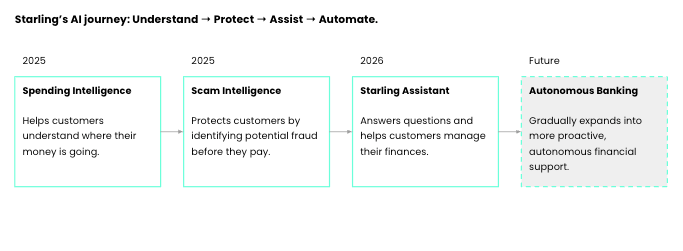
The bank first introduced Spending Intelligence, allowing customers to ask natural-language questions about their transactions, before launching Scam Intelligence to help identify potentially fraudulent payments.
Starling Assistant now brings those capabilities together and extends them into action, helping customers create savings goals, organise bills and automate regular transfers. Rather than asking customers to leap straight to autonomous banking, Starling has expanded the assistant's role in stages: from explaining, to protecting, to helping customers organise their finances.
By expanding from insight to action in carefully controlled stages, Starling demonstrates that trust is earned one successful interaction at a time.
3. Governance becomes part of the product
Too often, governance is treated as something that happens behind the scenes. As conversational AI becomes customer-facing, governance becomes part of the customer experience itself.
Good conversation design and great UX alone won't create trusted financial AI. Customers need confidence that an assistant knows its own limits, explains its reasoning and behaves predictably in high-stakes situations.
They need confidence that recommendations are accurate, compliant and aligned with their interests, and reassurance that the assistant will recognise uncertainty and involve a human when appropriate.
The firms that succeed will make governance visible:
- Make the boundaries explicit. Customers need clear distinctions between information, guidance, advice and execution. The more responsibility an assistant takes on, the more important those boundaries become.
- Make decisions transparent. Customers should understand why recommendations have been made, what information has been considered and when an assistant isn't confident enough to proceed.
- Embed risk and compliance into every interaction. Governance cannot be bolted on afterwards. Regulatory requirements, product rules and organisational policies must shape how assistants behave from the outset.
- Maintain human accountability. Financial providers remain responsible for the outcomes delivered through their AI assistants. Escalation paths, monitoring and human oversight remain essential as assistants become more autonomous.
The firms that earn lasting trust won't simply build assistants that are easy to use. They'll build assistants that customers, regulators and their own organisations can confidently rely on.
Financial services already has deep expertise in governance, risk management and customer protection. Those capabilities shouldn't be viewed as barriers to AI adoption. They may become one of the industry's biggest competitive advantages.
Case study: Lemonade
Designing clear boundaries for AI
Lemonade shows how governance can become a visible part of the customer experience rather than a control hidden behind it.
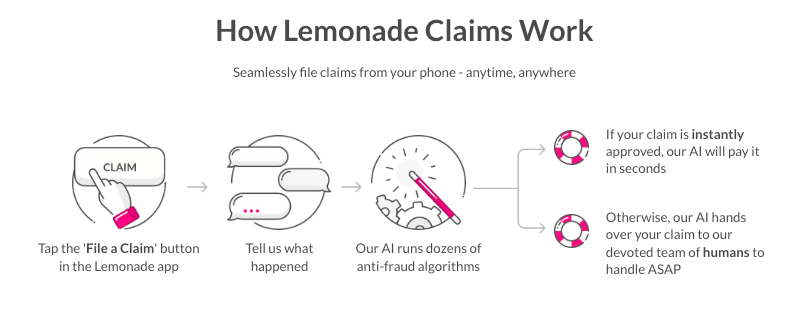
Its AI assistant, Jim, can collect claim information, verify policy details and approve straightforward claims within seconds, dramatically reducing waiting times for customers.
However, Lemonade deliberately draws a clear boundary around what the AI is allowed to do. While it can approve low-risk claims automatically, the company has stated that AI is never permitted to reject a claim or cancel a policy without human involvement.
Instead of trying to automate every claim, Lemonade has designed clear decision boundaries that determine when AI can act autonomously and when humans take over, with more complex or uncertain cases automatically escalated to specialist claims handlers. Governance isn't hidden behind the experience; it shapes the experience itself.
Trust is your competitive advantage
The race isn't to build the smartest AI assistant. It's to earn enough trust to remain part of the customer's financial decisions.
Financial AI won't succeed because customers believe it is intelligent. It will succeed because customers believe it consistently acts in their best interests: delivering good outcomes, recognising its limits and earning greater responsibility over time.
Ultimately, that's what trust has always meant in financial services. Conversational AI doesn't change that principle. It changes where trust is earned. As AI assistants become the interface through which customers discover, compare and act on financial products, trust becomes the gateway to distribution.
At 11:FS, we help financial institutions define AI strategy, identify the right opportunities and design trusted conversational experiences that customers trust.