Content Hub
.svg)
.svg)
Global

11:FS announces its American expansion
Sam Maule joins 11:FS as Managing Partner, Americas

Are challenger banks just better legacy banks?
This week I had the super-smart Mariano Belinky tell me that the current crop of challenger banks are really just ‘better mousetraps’.

The SEC's verdict on The DAO tokens: explained
A few weeks ago, I outlined the problems with the financial products that supposedly address small and medium sized businesses’ (SMBs) needs, and how they are chronically underserved by incumbent financial institutions (FIs) across all sectors. Since then, we’ve explored how things are changing in the SMB insurance space and delved into the developments in the areas of bank account opening, payments and loans in our podcasts. I’ve also been busy trying to discover, articulate and demonstrate what “best in class” in this industry looks like in my latest research report.

The virtues of digital : creating a truly digital bank
At 11:FS we like to say that digital banking is 1% finished, well the same is true of Open Banking. The unknown potential of the regulation far outstrips what is being done right now. And that potential has caught the imagination of foreign regulators.

DIGITAL TRANSFORMATION: THE GREAT LIE – Part 3 - The future is a fast moving target
Dave Bruno, Co-Founder at YNOME and Head of WM Innovation at UBS, explains how digital can scale wealth management for everyone.
Laurent le Moal - CEO, PayU on 250 ways to accept payment
The last few weeks have shone the spotlight on leadership teams at banks and how they have responded to the unprecedented circumstances created by a global pandemic.
Stefan Thomas, on Ripple, Interledgers & XRP
Jason Bates interviewed Stephen Barclay, MP – the Economic Secretary to the Treasury, for Fintech Insider Interviews to gauge his views on the UK fintech scene, and the government’s role in facilitating the rise of fintech, how fintech can help the government, what the impact of Brexit will be and the Treasury’s message to the rest of the world.
Digital Transformation: The Great Lie – Part 2. How do you know if you’re on track?
A three-part series by 11:FS Non-Executive Director, Lisa Gansky Last week Lisa discussed how to become truly digital you must take a leap of faith, ask questions, make a mess and ultimately shake up business models completely. True transformation must fully pervade an organisation’s culture; it must be far more than just a project. Read part 2 in full here

Tezos co-founders Kathleen & Arthur Brietman, on Tezos and token sales
The first few weeks of 2017 bombarded us with articles predicting the future of FinTech and financial services. Chris Skinner, our Non-Executive Director at 11:FS, analysed them all and identified the top 11 trends that the leading banking and FinTech experts agree we should be following now.

Why it’s good to be an SME
If you are an SME, the chances are you have been seriously neglected by your bank. Your accounting software or Excel spreadsheets are probably your only go to points to understand the state of your business. Your invoice management is likely to be scatty at best, and cash flow optimization is probably not something available in a few clicks. Oh, and it probably took you a couple weeks to actually apply and get your bank account.
Digital Transformation: The Great Lie - Part 1. The 3 steps of Digital Transformation
A three-part series by 11:FS Non-Executive Director, Lisa Gansky Last week Lisa discussed how becoming truly digital requires a leap of faith, to boldly go where no one else has yet gone, even if it seems crazy at the time, and to ignore basic human instinct asking how? where? how long? how far? She outlined the three steps on the journey: The Digital Makeover – ask never ending questions if you want to evolve The Joy of Decoupling – refashioning process and perspective Is That Even Legal? – Innovation that completely redefines norms Read part 1 in full here
Jonathan Larsen - CIO at Ping An - on their $1bn global fintech fund
65 million years ago, gigantic monster roamed the same places where today Starbucks and Costa Coffees are. Having dragged themselves out of the primordial goo and evolved themselves to the top of the food chain, the Dinosaurs were oversized in their appetites, attitudes and on top of the world. What can the monsters of today learn from the monsters of the past to avoid the extinction events that wiped out the dinosaurs? Let us explore, with Jurassic Park puns and quotes aplenty… hold on to your butts.

How will Financial Services operating systems and structures look in the future?
In the first of a new series we’re talking to our brilliant 11s to get to know them a little bit more. From the consultants building new digital propositions and the research team using cultural insights to inform them, through to the engineers bringing those services to market, the operations team that keeps the lights on, and everyone else in between.

Banks + FinTechs = Powerful new customer journeys
The talk of disruption of banking by fintech companies has quelled a little recently as realisation sets in as to just how difficult that actually is. The talk now is of partnerships between the two that mutually benefit both parties. We have not really seen many partnerships in the true sense between fintech and the old banks yet, they are still using fintechs in traditional vendor relationships.
Introducing Blockchain Insider!
As you may have noticed I’ve been doing a lot of teasing around this for the last few months. Well today...right now...is the grand reveal as we celebrate the public launch of our 11:FS values.
1107
1107: Insights: Can banks turn high earners into wealthy customers?
Earning a good salary doesn't necessarily mean building wealth. For a growing group of high earners, often referred to as HENRYs (High Earners, Not Rich Yet), the journey from financial success to long-term wealth can be surprisingly difficult.

1106
1106. News: ASOS hit by cyberattack, UK finance eyes tokenisation, and can open banking help tackle credit exclusion
Host Ross Gallagher- Head of Consulting at 11:FS - is joined by some great guests to discuss the biggest stories from the world of financial services over the past week.

1105
1105. Insights: Who owns the banking relationship in the AI era?
As AI becomes another interface between customers and their money, could banks lose their place at the centre of the financial relationship?

1104
1104. News: Nubank rules out Monzo takeover, Checkout.com opens the books, and Ramp hits Broadway
Welcome to this week’s Fintech Insider News podcast, where host Benjamin Ensor is joined by expert guests to unpack the biggest fintech and financial services stories of the week - and, for this week only, a little bit of theatre, darlings.
1102
1102. News: Amazon blocks Meta’s AI agent, Ryft raises £20m, and Sprive bags $10m
About this episode: Host Laura Watkins - Director of Media and Marketing at 11:FS - is joined by some great guests to discuss the biggest stories from the world of financial services over the past week. This week's guests: Sadra Hossein
1101
1101. Insights: Why does your financial life reset when you move countries? With Paymentology
About this episode: Moving countries has never been easier. But what happens when your financial identity doesn’t move with you? Host Benjamin Ensor is joined by Merusha Naidu, Global Head of Partnerships at Paymentology, Ibrahim Oladele
1100
1100. News- After Dark: Nubank takes on the US, Monzo Aura launches, and can you trust AI with your money?
Our expert host David M. Brear, CEO at 11, and co-host Kate Moody, Customer Strategy Director at 11, present a very special edition of Fintech Insider News live from Village Underground in London.

1098
1098. News: Chime buys Stride Bank, Molten raises £175m, UBS puts AI on the job spec
Host Ross Gallagher - Head of Consulting at 11:FS - is joined by some great guests to discuss the biggest stories from the world of financial services over the past week.

1096
1096. News: Singapore puts $173m behind fintechs, Plum picks Upvest, and US regulators tighten the rules
Host Benjamin Ensor - Director of Research and Strategy at 11:FS - is joined by some great guests to discuss the biggest stories from the world of financial services over the past week.

1095
1095. Insights: Is financial services failing Gen Z?
Gen Z is often told it needs to get better with money. But with younger people facing a very different economic reality, does Gen Z really have a financial literacy problem — or does financial services have a Gen Z problem?

1094
1094. News: UK fintech funding hits a decade low, NatWest backs accessible banking, and Pay.com.au takes on America
Host Kate Moody - Customer Strategy Director at 11:FS - is joined by some great guests to discuss the biggest stories from the world of financial services over the past week.

1093
1093. Insights: What it’s really like to start a fintech in 2026
Starting a fintech has never been easier but has building a successful one ever been harder? Host David M. Brear is joined by Fatbardha Rino, CEO of Jet Bank, and Herbie Wildwood, Founder of Legacy, to explore what it really takes to build

1092
1092. News: Finally, the robots take over: Starling gets smarter, Stripe buys OpenRouter, and Visa and Mastercard unite on agentic payments
Host Laura Watkins - Director of Media and Marketing at 11:FS - is joined by some great guests to discuss the biggest stories from the world of financial services over the past week.

1090
1090. News: Can anyone stop Revolut? Can Countingup and Griffin tackle SME pain? Can the FCA help UK fintechs scale?
Host Ross Gallagher - Head of Consulting at 11:FS - is joined by some great guests to discuss the biggest stories from the world of financial services over the past week.

1088
1088. News: Visa bets $2.4bn for BioCatch, InvestiFi raises $20m, and HSBC pulls back in Australia
Host Benjamin Ensor - Director of Research and Strategy at 11:FS - is joined by some great guests to discuss the biggest stories from the world of financial services over the past week.
Banks are losing the loyalty game | 11:FS Explores
Hey, banks! This might sting a bit. You’re getting loyalty all wrong - and it’s costing you customers. But all is not lost!
3 ways AI is shaking up UX in financial services | 11:FS Explores
The entire world is buzzing about AI, and that ain't changing anytime soon. But as AI becomes more integrated into our daily lives, what impact will it have on financial services and how people interact with them?
Using Jobs to be Done to revolutionise SME Banking | 11:FS Explores
It's not just a buzzword.





What are fintechs? - Decoding: Banks
Ever wanted to know what’s going on behind the scenes every time we make a payment?

How does banking regulation work? - Decoding: Banks
Regulation is essential. It stops banks from going bust or behaving badly.

How has software evolution influenced banking? - Decoding: Banks
The invention of the computer revolutionised banking in the 1950s.

How does lending work? - Decoding: Banks
Lending has been around for thousands of years and is one of the cornerstones of banking.

How can traditional banks win on the banking battlefield? - Decoding: Banks
They're down, but they're not certainly not out.

How do card networks operate? - Decoding: Banks
Mastercard and Visa are the two biggest credit card networks in the world.

How has the banking battlefield evolved? - Decoding: Banks
We kick off our Decoding: Banks series with a look at the banking landscape today and how we got here.
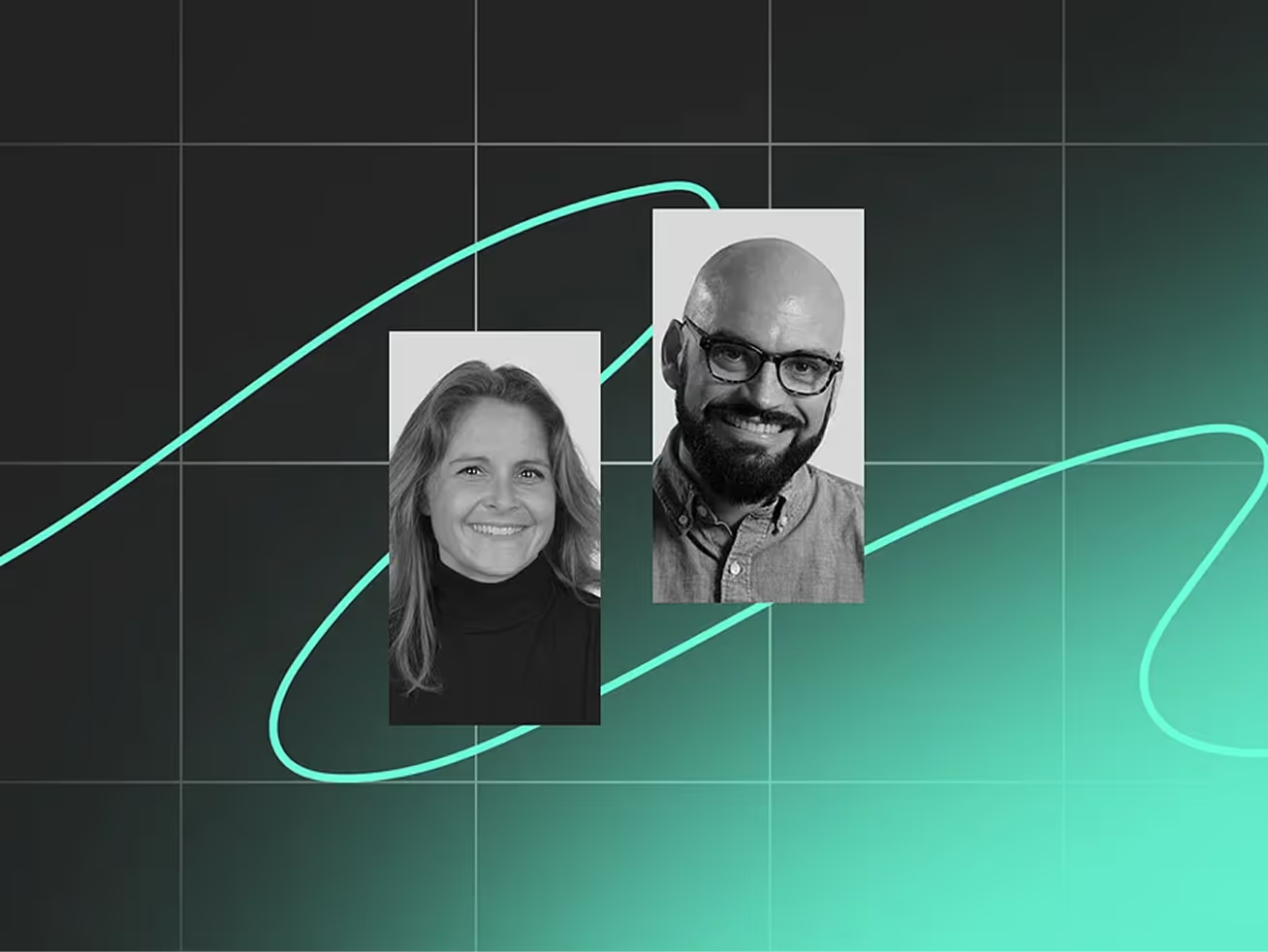
960
Insights: The future of Revolut with UKCEO Francesca Carlesi
The UK banking battlefield has never been more competitive. Customers expectfinancial apps that are personalised, seamless, and that genuinely make a differenc...
960
Insights: The future of Revolut with UKCEO Francesca Carlesi
960
Insights: The future of Revolut with UKCEO Francesca Carlesi
The UK banking battlefield has never been more competitive. Customers expectfinancial apps that are personalised, seamless, and that genuinely make a differenc...
960
Insights: The future of Revolut with UKCEO Francesca Carlesi
960
Insights: The future of Revolut with UKCEO Francesca Carlesi