Content Hub


Global

Banks must become active partners in financial wellbeing
Around the world, people have instant, around-the-clock access to banking apps and their own financial data. So why do so many people still feel uncertain about their financial future?

Vertical Agentic AI is the next frontier for value creation In financial services
Most AI deployments so far have focused on AI that “talks”, which can search, summarise, and draft content to support employees. The next wave is different: AI agents that “do” are starting to take bounded actions inside workflows, moving cases forward and coordinating steps end-to-end, with humans kept in control where it matters.

Accessibility in finance: Designing a future everyone can use
Financial accessibility has long been framed as a matter of compliance or corporate social responsibility. But today, it’s emerging as something much bigger: a competitive advantage.

The fight to win the salary battle
As the industry adjusts to a new digital landscape, players across the spectrum are fighting to muscle their way into the financial epicentre and ‘win’ the salary battle to become the payday home of their customers.

Personalised payments: enabling the choice and flexibility consumers expect
Consumers are evolving, and so are their expectations and demands. As the purchasing power of the younger, digital-native Gen Z and Gen Alpha grows and older generations become more comfortable with the possibilities that AI and other new technologies enable, businesses have to work harder to keep them happy and retain their business.

Gamification in fintech: Financial literacy or just engagement?
Saving money and paying bills might not sound exciting - but today’s finance apps are borrowing tricks from video games to change that.

Why the future of fintech depends on empowering SMBs
While consumer-focused fintech has seen waves of innovation since the early 2000s, the small and medium-sized business (SMB) sector has remained comparatively underserved.

Agentic AI is reshaping financial services
Unlocking agentic AI’s upside demands rethinking how humans and systems share control, rebuilding data and API foundations, and scaling autonomy in measured steps with rigorous human-style QA

How digital payouts offer a competitive edge to insurers
In the highly competitive insurance sector, customer experience is a critical differentiator. While insurers focus on policy features and premiums, the claims payout process is often overlooked, creating a significant point of friction.


I’ve incentivised innovation, why isn't my team innovating?
At one of our Truly Digital After Dark events, Anne Boden said “if you call yourself digital, you’re not digital”.

Tackling fraud in real time: balancing speed and security
The term ‘technical debt’ has been around a long time in software engineering. It shares some common characteristics with financial debt: You can accumulate it, you can ‘pay it off’.

5 fintechs to watch in Asia
The fintech scene in Asia is booming. In recent years, the region has developed rapidly, with a diverse array of startups and established banks transforming how financial services are delivered and consumed.


How internal adoption fuels successful embedded finance solutions
Payments in the Middle East are evolving. The payments landscape in the Middle East has stood at an important tipping point for some time.
147
147. State of the Union 2
Sam Maule hosts a very special episode of Fintech Insider from a flat in Toronto! Sam's joined by Mike Sigal from 500 Fintechs (part of 500 Startups), Dion Lisle from CapGemini, Jo Lang from IBM, and April Rudin from The Rudin Group.
146
146. What's the price of getting 5H1T done?
This week Jason, David and Simon are joined by Sharon O'Dea, consultant, advisor, and blogger, and Kadhim Shubber, Tech 100 #68 and FT Alphaville journalist to discuss the week's top news.
17
17. Bitcoin price explodes, ICOs implode and CEO of Ripple Interview
This week Simon and Colin talk through the Bitcoin good news story as well as Tezos, R3, and much more. Plus, we hear Sam Maule talk to Brad Garlinghouse, CEO of Ripple.
144
144. Live from Xerocon: part 1
This week, we cover David's time at Xerocon, where he hosted a panel on Frictionless Finance featuring Niall Cameron, Global Head of Digital at HSBC, Caroline Plumb OBE, CEO at Fluidly, Colin Goldstein, Head of Partnerships at iwoca, Stewart Roberts, Executive VP at iZettle, and Shachar Bialick, CEO at Curve.
143
143. News: O Canada!
This week Sam is joined by Kris Hansen, CTO at Koho, Dan Eberhard, founder of Koho, Barb MacLean, Director at Celero Solutions and Zac Cohen, General Manager at Trulioo in a special news show brought to you from Toronto, Canada.
4
4: InsureTech Connect, Las Vegas
In this week’s jam-packed show Nigel visits InsureTech Connect in Las Vegas and talks to Darin Reffitt, Vice President of Marketing at Splice Software; Quentin Colmant, co-Founder of Qover; Tim Hardcastle, CEO of Instanda; Chris Cheatham, CEO of Risk Genius; and Caribou Honig himself, co-founder of InsureTech Connect.
16
16. Eth and Bitcoin forks, Bitcoin all-time high and Ripple vs R3
This week Simon Taylor and Colin G Platt delve into the week's top blockchain and crypto news, and we hear from Brian Behlendorf, Executive Director at the Hyperledger Project within the Linux Foundation, and from Paul Worrall, founder of Zonafide.
142
142. Insights: PSD2 Round Table
Jason Bates talks to Gavin Littlejohn, Mike Kelly, Anita Kimber and Matt Cox about PSD2 - what is it and what does it mean for the industry?
141
141. The future will be tokenised
Meaghan Johnson is joined by the 11:FS Pulse team's Benedict Shegog, as well as Fintech Insider favourites Liz Lumley, Sarah Kocianski and Charlie Wood.
140
140. Interview: Niall Cameron, HSBC
This week David Brear talks to Niall Cameron, Global Head of Institutional and Digital at HSBC about strategy, growth and fintech.
15
15. What the hell is Segwit2x, enterprise Blockchain and more regulators weigh in
Simon and Colin explore the week's news, plus special interviews with Scott Nelson, CEO and Chairman of Sweetbridge, and Abasa Phillips, founder of Zilla.
15
15. What the hell is Segwit2x, enterprise Blockchain and more regulators weigh in
Simon and Colin explore the week's news, plus special interviews with Scott Nelson, CEO and Chairman of Sweetbridge, and Abasa Phillips, founder of Zilla.
139
139. Interview: Ron Herman, Sionic Mobile & Michael Crawford, Fifth Third
On this week's episode, Sam talks to Ron Herman, founder and CEO at Sionic Mobile, and Michael Crawford, Vice President at Fifth Third.
138
138. News: The Brexit Blame Game
This week David is joined by Bianca Lopes, Sarah Kocianski and Jamie Campbell.
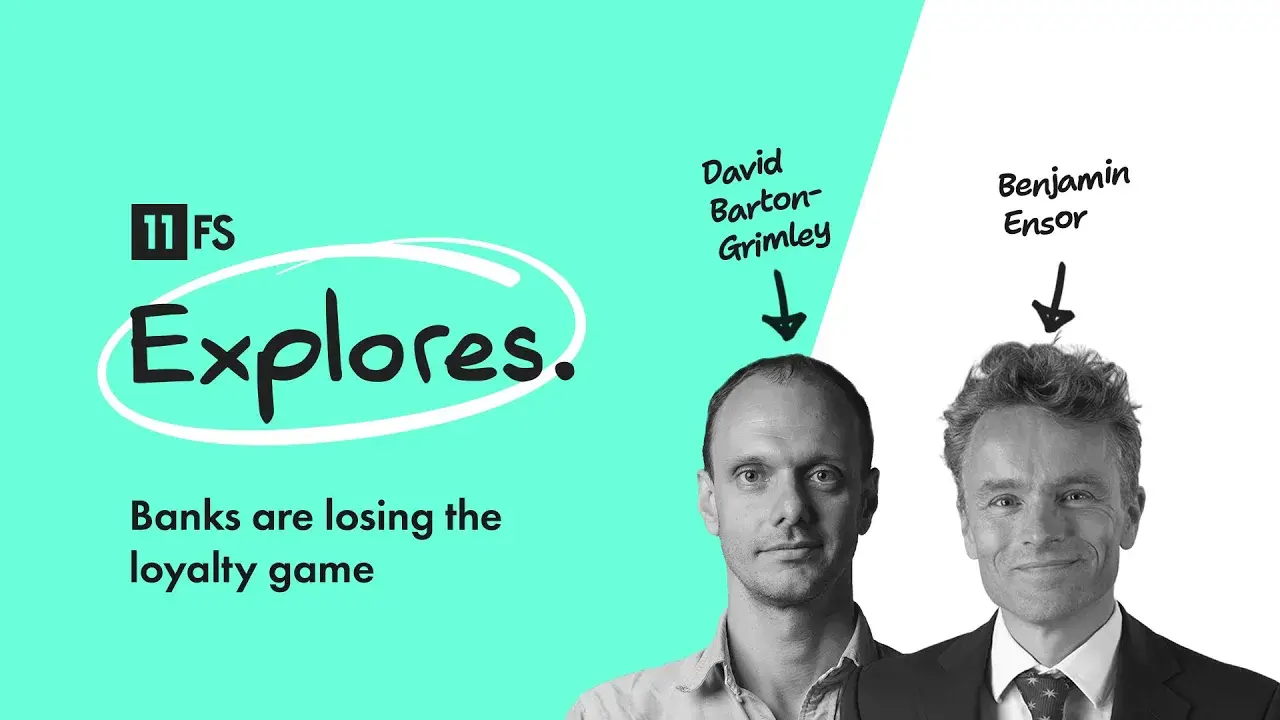
Banks are losing the loyalty game | 11:FS Explores
Hey, banks! This might sting a bit. You’re getting loyalty all wrong - and it’s costing you customers. But all is not lost!

3 ways AI is shaking up UX in financial services | 11:FS Explores
The entire world is buzzing about AI, and that ain't changing anytime soon. But as AI becomes more integrated into our daily lives, what impact will it have on financial services and how people interact with them?
Using Jobs to be Done to revolutionise SME Banking | 11:FS Explores
It's not just a buzzword.





What are fintechs? - Decoding: Banks
Ever wanted to know what’s going on behind the scenes every time we make a payment?

How does banking regulation work? - Decoding: Banks
Regulation is essential. It stops banks from going bust or behaving badly.

How has software evolution influenced banking? - Decoding: Banks
The invention of the computer revolutionised banking in the 1950s.

How does lending work? - Decoding: Banks
Lending has been around for thousands of years and is one of the cornerstones of banking.

How can traditional banks win on the banking battlefield? - Decoding: Banks
They're down, but they're not certainly not out.

How do card networks operate? - Decoding: Banks
Mastercard and Visa are the two biggest credit card networks in the world.

How has the banking battlefield evolved? - Decoding: Banks
We kick off our Decoding: Banks series with a look at the banking landscape today and how we got here.

960
Insights: The future of Revolut with UKCEO Francesca Carlesi
The UK banking battlefield has never been more competitive. Customers expectfinancial apps that are personalised, seamless, and that genuinely make a differenc...
960
Insights: The future of Revolut with UKCEO Francesca Carlesi
960
Insights: The future of Revolut with UKCEO Francesca Carlesi
The UK banking battlefield has never been more competitive. Customers expectfinancial apps that are personalised, seamless, and that genuinely make a differenc...
960
Insights: The future of Revolut with UKCEO Francesca Carlesi
960
Insights: The future of Revolut with UKCEO Francesca Carlesi