Content Hub
.svg)
.svg)
Global

Banks must become active partners in financial wellbeing
Around the world, people have instant, around-the-clock access to banking apps and their own financial data. So why do so many people still feel uncertain about their financial future?

Vertical Agentic AI is the next frontier for value creation In financial services
Most AI deployments so far have focused on AI that “talks”, which can search, summarise, and draft content to support employees. The next wave is different: AI agents that “do” are starting to take bounded actions inside workflows, moving cases forward and coordinating steps end-to-end, with humans kept in control where it matters.

Accessibility in finance: Designing a future everyone can use
Financial accessibility has long been framed as a matter of compliance or corporate social responsibility. But today, it’s emerging as something much bigger: a competitive advantage.

The fight to win the salary battle
As the industry adjusts to a new digital landscape, players across the spectrum are fighting to muscle their way into the financial epicentre and ‘win’ the salary battle to become the payday home of their customers.

Personalised payments: enabling the choice and flexibility consumers expect
Consumers are evolving, and so are their expectations and demands. As the purchasing power of the younger, digital-native Gen Z and Gen Alpha grows and older generations become more comfortable with the possibilities that AI and other new technologies enable, businesses have to work harder to keep them happy and retain their business.

Gamification in fintech: Financial literacy or just engagement?
Saving money and paying bills might not sound exciting - but today’s finance apps are borrowing tricks from video games to change that.

Why the future of fintech depends on empowering SMBs
While consumer-focused fintech has seen waves of innovation since the early 2000s, the small and medium-sized business (SMB) sector has remained comparatively underserved.

Agentic AI is reshaping financial services
Unlocking agentic AI’s upside demands rethinking how humans and systems share control, rebuilding data and API foundations, and scaling autonomy in measured steps with rigorous human-style QA

How digital payouts offer a competitive edge to insurers
In the highly competitive insurance sector, customer experience is a critical differentiator. While insurers focus on policy features and premiums, the claims payout process is often overlooked, creating a significant point of friction.


I’ve incentivised innovation, why isn't my team innovating?
At one of our Truly Digital After Dark events, Anne Boden said “if you call yourself digital, you’re not digital”.

Tackling fraud in real time: balancing speed and security
The term ‘technical debt’ has been around a long time in software engineering. It shares some common characteristics with financial debt: You can accumulate it, you can ‘pay it off’.

5 fintechs to watch in Asia
The fintech scene in Asia is booming. In recent years, the region has developed rapidly, with a diverse array of startups and established banks transforming how financial services are delivered and consumed.

How internal adoption fuels successful embedded finance solutions
Payments in the Middle East are evolving. The payments landscape in the Middle East has stood at an important tipping point for some time.
29
29. Kraken on With Crypto After the Market Bloodbath
Simon Taylor and Colin G Platt discuss the crypto bloodbath we're currently witnessing, Kraken returning as well as bringing you interviews with two Ryan's, Blockstack founder Ryan Shea and the Two Bit Idiot & international man of mystery himself Ryan Selkis.
170
170. Understanding Wealth: the Best Asset of Asset Managers
Simon Taylor is joined by Pete Townsend, Chris Mills and Zeynep Meric-Smith to discuss where asset management is heading for in 2018.
169
169. FCA Crashes the BYOD Party
In this episode David and Jason were joined by colleagues Pete Townsend and Ross Gallagher (making his Fintech Insider debut), from our Pulse and Research Team, to tackle the latest news from the last week, alongside regular guests Sarah Kocianski and Charlie Wood. Regulatory based news unsurprisingly steals the limelight, however we also bring you that outrageous Kodak stock rise as well as and an interview with Claudia Bate- Author of "The Fads, The Fears and The Future" where overhyped trends and technologies are discussed.
28
28. Where now for Ripple? & Blockchain gets all Zuck'ed up
Simon Taylor and Colin G Platt discuss Ripple's monumental rise, Bitconnect and an interview with Ville Sointu from Nordea.
167
167. Insights: A Wealth of Disruption - How Wealth Management is Changing
Simon Taylor heads up an insights show focusing on wealth management, what it is and how it differs from asset management. He is joined by special guests Joe Parkin, Gemma Godfrey, Phil Smith, Olivia Vinden & Gareth Johnson.
166
166. News: 'Tis the Season for Open Banking
We kick off 2018 with an all 11:FS cast as Simon Taylor, David M. Brear, Andra Sonea & Benedict Shegog discuss this weeks top news including upcoming regulation and the impact of open banking.
27
27. XRP's Ripple effect and Blockchain use cases
In the first show of 2018 Simon Taylor and Colin G Platt bring you the week's news, plus an interview with Coindesk's Peter Rizzo.
26
26. Holiday Interview Special - Tim Swanson, & Somil Goyal: Adjoint
As it's the Christmas break we are not here this week, so instead of the usual news overview we're giving you an interview-only special show, featuring Tim Swanson and Somil Goya from new smart contracts start up Adjoint.
162
162. Festive Fintech Blooper Reel
Seasons Greetings to all our listeners! We bring you a festive hamper of outtakes from over the last year on Fintech Insider!

6
6: Aviva Takeover
In this episode, host David Brear and co-hosts Nigel Walsh and Sarah Kocianski visit Aviva's Digital Garage for InsurTech Insider's very first takeover show!
161
161. After Dark III Christmas Special
It's the After Dark Christmas Special and that means we're bringing you a recap of all the top stories from 2017, recorded in front of a live audience. Regular hosts Simon Taylor, David M. Brear, Jason Bates and Chris Skinner are joined by friends of the show Sarah Kocianski and Leda Glyptis.
160
160. State of the Union 3
Sam Maule hosts the latest State of the Union show, recorded live from the South East Fintech Venture Conference in Charlotte, North Carolina.
24
24. CBOE futures, Bitcoin mining energy usage & investing responsibly
Colin G Platt rejoins Simon Taylor for a second consecutive show in London to break down the week's news.
159
159. News: Mascots of the Internet
Jason Bates and Simon Taylor are joined by Kadhim Shubber, Liz Lumley, Sarah Kocianski and wonderful surprise guest Ghela Boskovich.
158
158. Insights: Perfect storm for change and digitisation
Jason Bates talks to a crack team of experts to find out about the pressures facing small businesses and the solutions that rapid technological change can provide
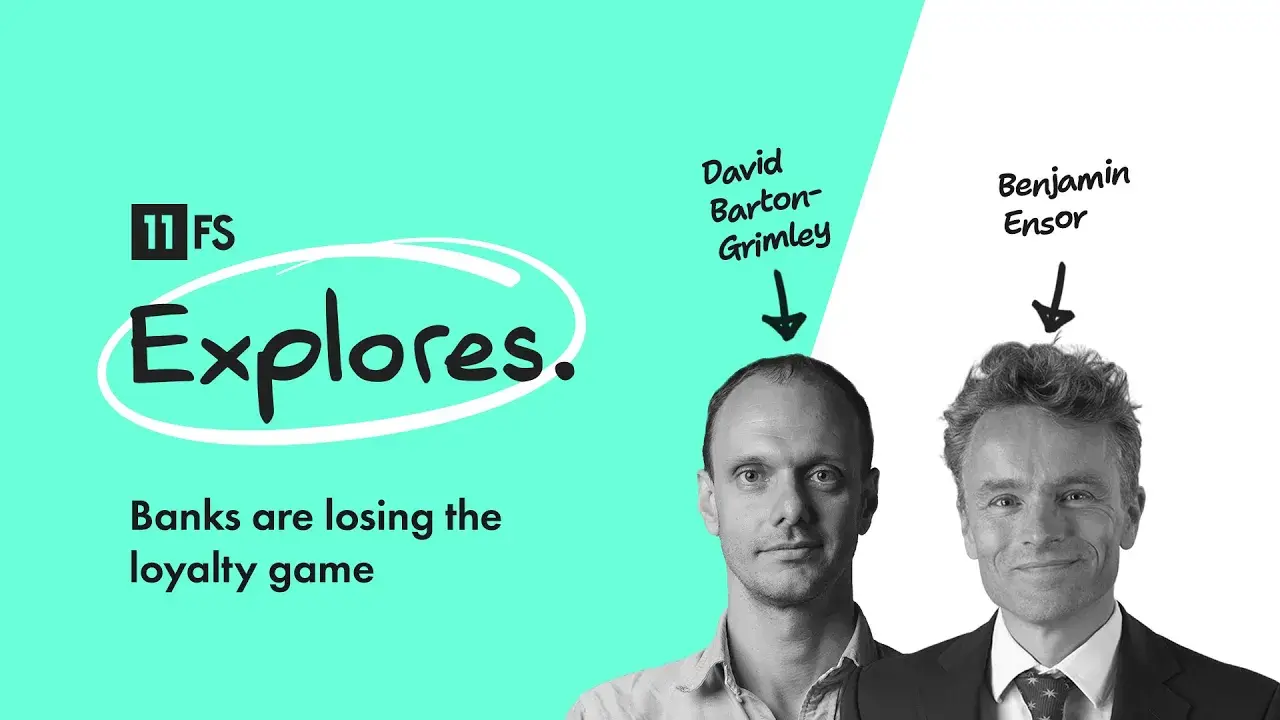
Banks are losing the loyalty game | 11:FS Explores
Hey, banks! This might sting a bit. You’re getting loyalty all wrong - and it’s costing you customers. But all is not lost!
3 ways AI is shaking up UX in financial services | 11:FS Explores
The entire world is buzzing about AI, and that ain't changing anytime soon. But as AI becomes more integrated into our daily lives, what impact will it have on financial services and how people interact with them?
Using Jobs to be Done to revolutionise SME Banking | 11:FS Explores
It's not just a buzzword.




What are fintechs? - Decoding: Banks
Ever wanted to know what’s going on behind the scenes every time we make a payment?

How does banking regulation work? - Decoding: Banks
Regulation is essential. It stops banks from going bust or behaving badly.

How has software evolution influenced banking? - Decoding: Banks
The invention of the computer revolutionised banking in the 1950s.

How does lending work? - Decoding: Banks
Lending has been around for thousands of years and is one of the cornerstones of banking.
How can traditional banks win on the banking battlefield? - Decoding: Banks
They're down, but they're not certainly not out.

How do card networks operate? - Decoding: Banks
Mastercard and Visa are the two biggest credit card networks in the world.

How has the banking battlefield evolved? - Decoding: Banks
We kick off our Decoding: Banks series with a look at the banking landscape today and how we got here.

960
Insights: The future of Revolut with UKCEO Francesca Carlesi
The UK banking battlefield has never been more competitive. Customers expectfinancial apps that are personalised, seamless, and that genuinely make a differenc...
960
Insights: The future of Revolut with UKCEO Francesca Carlesi
960
Insights: The future of Revolut with UKCEO Francesca Carlesi
The UK banking battlefield has never been more competitive. Customers expectfinancial apps that are personalised, seamless, and that genuinely make a differenc...
960
Insights: The future of Revolut with UKCEO Francesca Carlesi
960
Insights: The future of Revolut with UKCEO Francesca Carlesi